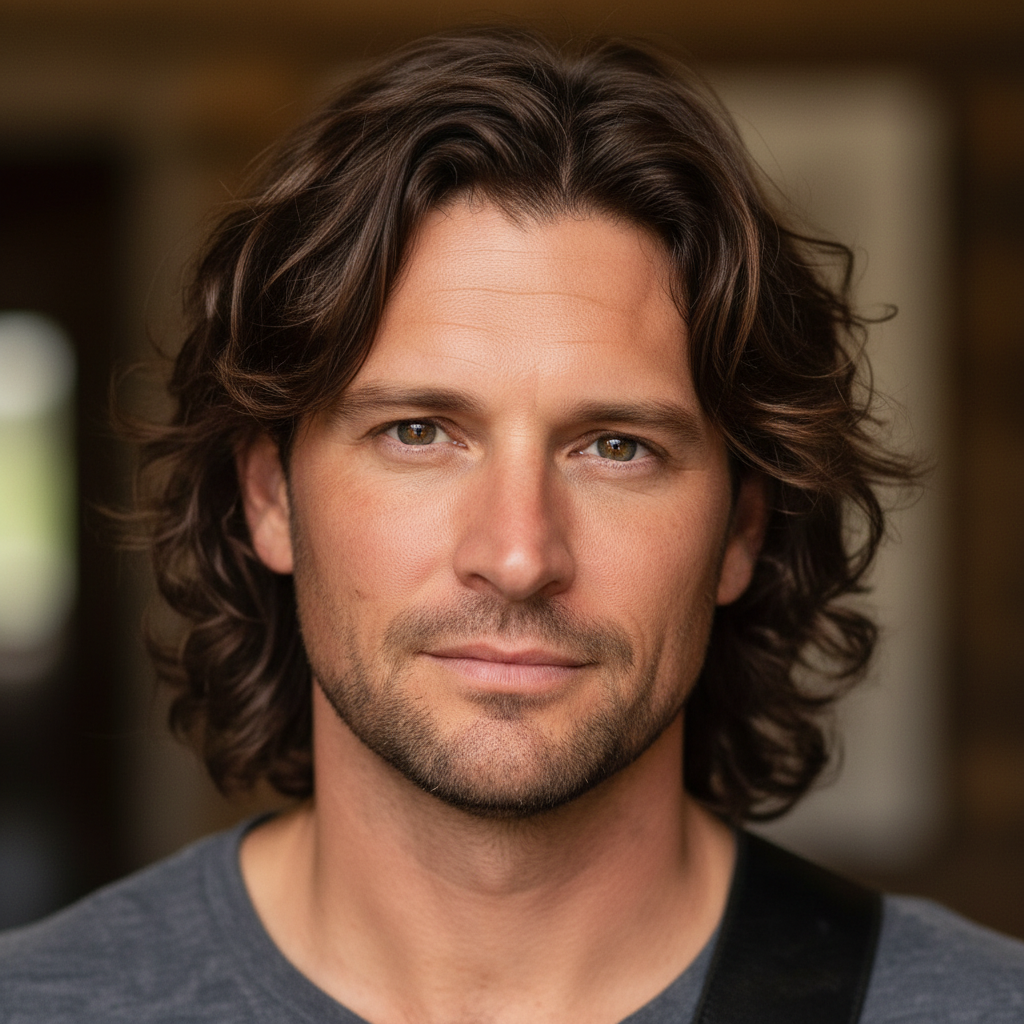
Norton Davis
Guitar • Vocals • Songwriter
Norton Davis's story begins in Rancho Cordova, California, in a childhood shaped by both hardship and the search for something better. Home was often a difficult place.
His parents drank heavily, expectations were high, and the atmosphere could become harsh and even violent. Norton and his siblings learned early to stay out of the way, finish their chores, and find whatever peace they could outside the house.
For Norton, that peace often came beside the American River with his fishing pole and his dog, Pappy, a gentle poodle mix who became his closest companion.
The river also led Norton to Ernie and Martha Tanaka, a Japanese couple who lived nearby on several acres filled with fruit trees, vegetables, chickens, and a roadside produce stand. Ernie treated Norton with respect and patience, teaching him how to fish for salmon, steelhead, and trout, how to garden, and how to care for lawns and landscapes.
Ernie became an important mentor and one of the first adults in Norton's life to make him feel capable and valued.
In 1967, when Norton was in third grade at Peter Shields Elementary School, he met Josephine "Josie" Wagoner. Their friendship began in an unlikely way.
Norton teased Josie in front of his friends, insisting that girls could not do anything as well as boys. Josie finally had enough and fought back.
Both were suspended, and Josie was told to bring Norton something when they returned to school. She arrived with a decorated shoebox filled with double chocolate chip cookies.
At lunch they sat together on a breezeway bench, shared the cookies, and talked honestly for the first time. When Norton admitted that he had teased her because he wanted to know her but did not know how to ask, Josie introduced herself.
Norton did the same. That awkward handshake became the beginning of a lifelong friendship and musical partnership.
Josie's home was very different from Norton's. Her mother was warm and welcoming, her younger brother adored her, and although her father, Jorge, was ill and the family had very little money, the house felt safe.
Norton began spending more and more time there. He helped repair Josie's bicycle, worked around the house, and soon became part of the family's daily life.
Music entered Norton's life at about the same time. His uncle Hector, a talented jazz guitarist, learned that Norton's father would not allow him to study trumpet because it was too loud.
Hector responded by buying Norton a guitar. He gave him a lesson book, taught him chords, picking and strumming patterns, and showed him how to play the folk songs Norton heard on the radio.
Norton practiced constantly. The guitar became another refuge, joining Pappy, the river, and Josie as the few things that made his world feel steady.
Norton was also determined to earn his own money. He mowed lawns, babysat, did chores, and even sold fresh mistletoe door to door at Christmas.
When he realized how tight money was in Josie's household, he made a deal with her: if she helped him with lawn work, they would use part of what they earned to buy groceries for her family every Saturday. The plan quickly grew into Norton and Josie's Lawn Service.
At only nine years old, they printed door hangers, built a customer list, opened joint checking and savings accounts, and were soon caring for dozens of yards. Ernie and Martha helped with tools, equipment, and practical advice, and the two children developed a reputation for doing careful, dependable work.
The lawn business and music grew side by side. When a neighbor offered a spinet piano for sale, Norton used money from his savings to help Josie get it.
He had the piano tuned, and Josie began taking lessons at Rancho Cordova Music Store. Every evening, Norton brought his guitar to Josie's room and they practiced together.
Their playing became part of the rhythm of their lives, alongside school, yard work, family responsibilities, church, and long conversations.
As they grew older, Norton and Josie expanded their little business into landscaping, gardening, plant propagation, and sprinkler installation. They built a greenhouse, restored equipment, worked on an old Volkswagen, and learned how to organize their time with unusual discipline.
Despite their workload, both continued to earn excellent grades. Norton also spent more and more time living with the Wagoner family, where he found the warmth and sense of belonging that had been missing from his own home.
Uncle Hector continued to guide Norton's musical development. He began working with Norton and Josie together, helping them learn how guitar, piano, and voices could fit as one sound.
Norton eventually bought the Fender Telecaster and Martin D-28 he had long wanted, while Josie expanded into electric piano and synthesizer. By then, music was no longer simply a refuge.
It was becoming the direction of their lives.
One of the defining events of their adolescence came in March 1972, when Josie's father, Jorge, died suddenly. Norton stayed beside Josie and her mother, helped make the funeral arrangements, contacted the church and mortuary, and shared the financial burden with Josie.
In the months afterward, he and Josie helped her mother rebuild a sense of normal life. They renovated rooms, replaced furniture, encouraged her to pursue the college education she had always wanted, and continued to keep the household and their lawn business moving forward.
The experience deepened Norton's instinct to take responsibility for the people he loved.
By the early 1970s, Norton and Josie's musical partnership was ready to become a band. They met drummer Randy Morgan and bassist Kathy Barton, and Norton converted much of the Wagoner garage into a rehearsal studio.
Uncle Hector coached the group on musicianship, ensemble playing, and singing. Norton began writing songs, while the group developed both acoustic and electric arrangements built around guitar, piano, bass, drums, and strong three-part harmonies.
By the end of tenth grade, the group had a polished set list of roughly sixty songs, including about twenty originals. This was the beginning of The Norton Davis Band.
The band became a regular choice for school dances, Christian and Catholic youth events, picnics, and performances throughout Northern California. Through Hector they found a booking agent, purchased professional sound and lighting equipment, and eventually acquired a used Winnebago that became their band bus.
Norton and Josie hired help for the lawn business so they could devote more time to music.
As the band's profile grew, Norton remained cautious about giving up creative control. When a record executive showed interest, Norton was not ready to be owned by a contract, so he chose to finance an album of his own original songs instead.
That independence, together with his songwriting and musicianship, became part of the character of the band from its earliest years.
Norton Davis became the founder, guitarist, vocalist, and principal songwriter at the center of The Norton Davis Band. His story is inseparable from Josie's, but it also carries its own thread: a boy who found refuge in a guitar, learned self-reliance through work, discovered family in unexpected places, and turned the experiences of his life into music and stories.
From the American River to a garage rehearsal room, and from childhood hardship to a band of his own, music became the way Norton made sense of the world and shared it with others.
The Norton Davis Band members are fictional characters in Skip Green’s original music and storytelling project, inspired by a lifetime of real experiences.